

BYLINES NETWORK SPECIAL – after Keir Starmer's speech, an abuse survivor speaks: "The prime minister must answer to us."
Survivor Shanta Sundarson reveals that the government has failed to give a clear answer to calls for a statutory public inquiry into the abuse of over 400 women at the hands of Mohammed Al Fayed.
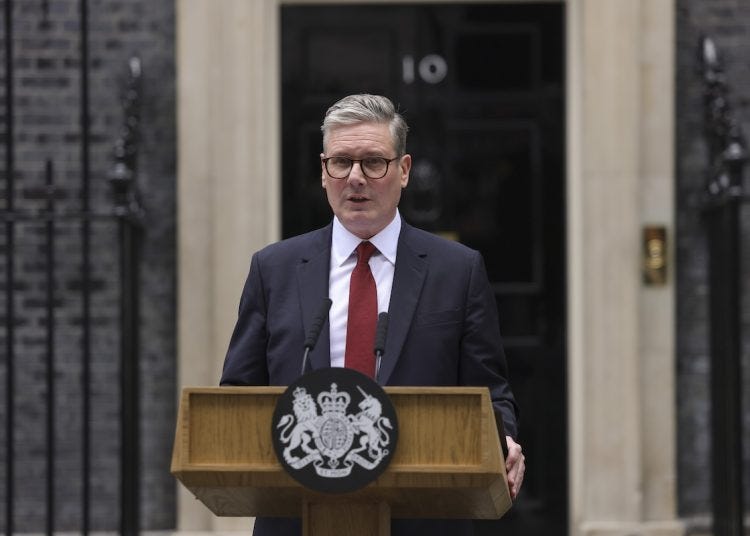
Welcome to the latest Best of Bylines newsletter. This time, we bring you a powerful response to Prime Minister Keir Starmer’s claim that the UK “will not look away” when women and girls are trafficked and abused by powerful men. He was talking about Jeffrey Epstein, following revelations about his ongoing relationship with Lord Mandelson. Yet, for several months, Bylines Network publications have carried stories from survivors of another powerful man – one based in the UK and whose victims are still seeking justice 30 years after the scandal of his abuses first became public.
Mohammed Al Fayed presided over the abuse of more than 400 women and girls whilst running his Harrods empire. Survivors have been bravely telling their stories and explaining why they feel the justice system has failed them, in Bylines Cymru, Central Bylines, Sussex Bylines and Yorkshire Bylines. MPs have championed their cause and on Friday, we published Isbella’s immediate reply to the Prime Minister’s statement that his government would “not shrug our shoulders” in the face of such atrocities:

Today, we bring you a response from another survivor – Shanta Sundarson, who reveals why she believes requests for a statutory inquiry into the allegations linked to Harrods, the late Mohammed Al Fayed, and associated institutions, have been deflected. It’s a powerful article that raises far-reaching questions about this case and the commitment of the government to take action in support of abuse and trafficking survivors.
You can read Shanta’s words or watch her video below, recorded the day after Kier Starmer’s speech. Bylines Network is here to champion the voices of unheard citizens – if you think this story matters as much as we do, please share it and subscribe to receive the stories that matter directly to your inbox.

By Shanta Sundarson.
On 27 May 2025, I wrote to the prime minister, Keir Starmer MP, requesting the establishment of a statutory public inquiry under the Inquiries Act 2005 into allegations linked to Harrods, the late Mohamed Al Fayed, and associated institutions. An inquiry into systemic abuse, institutional failure, and state response failures. In other words, the failures that allow exploitation to persist not because of ignorance, but because power, proximity, and reputation are treated as a shield.
It was not a rhetorical appeal. It was not an attempt to weaponise public outrage. It was a formal request to invoke a legal mechanism designed specifically for moments when public confidence has been compromised and when systemic failures demand scrutiny.
What followed has not been a decision, but a deflection.
And the longer the government avoids providing a clear answer, the more serious the question becomes: has the prime minister effectively refused a statutory inquiry – and if so, why?
A request for accountability, not political theatre
I contacted Downing Street on behalf of survivors seeking justice and public accountability in relation to detailed and consistent allegations spanning over 30 years, that are increasingly difficult for Britain to ignore.
Hundreds of survivors have now come forward with credible accounts of:
a multi-decade system of organised sexual abuse and exploitation;
intimidation, threats of harm, and retaliation for disclosure;
the use of non-disclosure agreements (NDAs) and institutional pressure to suppress complaints;
failures within Harrods’ management to intervene or safeguard;
failures by public bodies to investigate, prosecute, or meaningfully respond.
These allegations are not isolated. They describe patterns. And patterns matter because they point beyond individual perpetrators toward institutional ecosystems that enable harm.
The effective muting of survivors through these mechanisms describes an architecture of control that obstructs justice and prevents others from coming forward.
These are the dynamics that have surfaced in other national scandals. They are the dynamics of institutional abuse.
Trafficking allegations cannot be managed quietly
My request also referenced deeply troubling reports involving human trafficking, covert surveillance, and intimidation of survivors and whistleblowers.
The allegations include the transportation of employees or prospective employees to and from Harrods or other locations, and recruitment into fabricated roles with proximity to Mohamed Al Fayed and members of his family, for the purpose of sexual exploitation.
Such tactics resemble coercive mechanisms associated with organised criminal networks: a blend of grooming, intimidation, dependency, isolation, and control. If these accounts are even partially true, they raise urgent questions not only about criminal conduct, but about institutional complicity and state failure.
The UK government cannot credibly claim that violence against women and girls is a national emergency while allowing allegations of this scale to be processed as though they are merely an employment dispute or a corporate reputational matter.
A specific and lawful request
The Inquiries Act 2005 exists precisely because there are circumstances where public accountability cannot be achieved through criminal trials alone.
A statutory inquiry has powers that matter:
to compel witnesses
to require disclosure of documents
to take evidence under formal procedures
to examine institutional and regulatory failures
to establish a public record
The point of such an inquiry is not to replace criminal justice, but to confront systemic breakdown: the failures of organisations, regulators, police, and political decision-makers that allow abuse to persist.
I explicitly requested a survivor-centred inquiry to determine how abuse could allegedly continue within a high-profile British institution over decades, and to examine the actions and omissions of those in positions of responsibility.
The proposed scope included not only internal safeguarding failures at Harrods but potential criminal liability for acts not currently addressed under compensation mechanisms, such as unlawful surveillance, intimidation, harassment, drugging with intent to commit sexual abuse, false imprisonment, and trafficking for sexual exploitation.
I also urged examination of the knowledge, involvement, and potential culpability of Mohamed Al Fayed’s estate and close associates, and the conduct of law enforcement and regulatory bodies, including whether there was corruption, misconduct, or wilful failure to act.
I further raised the issue of NDAs – how they may have been used not simply as private settlement tools, but as institutional instruments of suppression.
And I made clear that survivors and advocates were willing to participate in scoping discussions and provide supporting materials, including anonymised testimonies.
This was not a vague appeal. It was a structured request.
The Home Office replied – but did not answer
On 30 June 2025, I received a response from the Home Office Interpersonal Abuse Unit, referencing my letters to the Prime Minister.
The response began with standard acknowledgements of the devastating impact of sexual violence and trafficking, the importance of treating victims with dignity, and the expectation that investigations be thorough.
Then it pivoted to the familiar shield:
“The Government and its Ministers are unable to intervene in, or comment on, the circumstances of individual cases.”
But I did not ask ministers to intervene in an individual case. I asked the prime minister to exercise a statutory power to establish an inquiry into systemic failures.
The reply then invoked the operational independence of police and courts, and claimed that inquiries require careful consideration, particularly where there may be ongoing proceedings.
This is neither a refusal nor an acceptance. It is a carefully constructed non-answer: a generic template response. It is not a clear response to a formal statutory inquiry request.
It is policy language in place of accountability.
Strategy has become a substitute for action
The Home Office letter closed with statements about violence against women and girls being a top government priority and the development of a new cross-government strategy.
For decades, institutions have responded to scandal with new strategies, frameworks, and reviews – while survivors are left navigating hostile legal processes, private compensation schemes, and the quiet erosion of evidence.
Britain does not suffer from a lack of strategies. It suffers from a lack of consequences.
A national strategy cannot compel disclosure. It cannot subpoena documents. It cannot compel testimony. It cannot expose who knew what, when, and what was ignored.
A statutory inquiry can.
If the government genuinely views violence against women and girls as a national emergency, it must demonstrate that commitment not only through future strategy documents but through meaningful examination of historic institutional failures.
Otherwise, the phrase becomes empty: a headline without substance.
Help us give a voice to survivors

We’re proud to enable citizens like Shanta to speak truth to power. We are free to publish and share stories like this because we are also proudly independent – no corporate owners or billionaire backers. But it costs us at least £150,000 a year to run our network. We’re proud to give a platform to survivors of abuse and injustice. Support journalism by the people, for the people. Become a Friend of Bylines Network. For as little as £3.50 a month, you’ll get behind-the-scenes insights, chances to engage with our editorial teams, access to special events, merchandise, and more. Sign up by clicking the button below, or upgrade your Substack subscription.
If survivors matter in New York, they matter in London
British political commentary is saturated daily with moral certainty about Jeffrey Epstein and his associates.
In the headlines about Peter Mandelson – whether he should testify, about who knew what and when – politicians speak with justified outrage about a system that enabled a powerful abuser abroad.
Epstein’s survivors deserve seriousness, truth, and accountability.
But on British soil, hundreds of women have now come forward with consistent, credible accounts of exploitation linked to Mohamed Al Fayed and facilitated through Harrods, one of the most recognisable institutions in British public life.
Yet there seems to be no urgency, no calls for testimony, no political demand for a full public reckoning for them.
If politicians are sincere about accountability, then it cannot stop at the Atlantic.
If it is a scandal when powerful men exploit women through wealth, access, and institutional protection in New York, then it is also a scandal when it happens in London, operating openly for decades inside a flagship British institution.
If survivors matter in the Epstein case, then they matter here too.
Right now, it is hard to escape the impression that some scandals are treated as politically convenient to condemn, while others – closer to home, implicating British institutions – are quietly encouraged to fade into silence.
Four parliamentary questions that must be put on the record
One of the most effective ways to force government accountability can be for MPs to table parliamentary questions – forcing the prime minister to place the government’s position on the public record. Journalists, too, should be asking these same questions of government. The four questions that the prime minister needs to address are:
Decision Status: Has the prime minister considered a request dated 27 May 2025 for the establishment of a statutory public inquiry under the Inquiries Act 2005 into allegations of sexual abuse, institutional failure and state response failures linked to Harrods and Mohamed Al Fayed? On what date was that request considered?
Criteria Applied: Can the prime minister confirm what criteria were applied in deciding whether to establish a statutory public inquiry under the Inquiries Act 2005 in response to correspondence received on 27 May 2025 concerning allegations linked to Harrods and Mohamed Al Fayed?
Compulsion Powers: Can the prime minister describe what assessment was made of the necessity for statutory powers of compulsion under the Inquiries Act 2005 in relation to allegations of systemic abuse and institutional failure linked to Harrods and Mohamed Al Fayed?
Reasons (if refused): Can the prime minister say, if the Government has decided not to establish a statutory public inquiry under the Inquiries Act 2005 in relation to allegations linked to Harrods and Mohamed Al Fayed, what the legal basis for that decision is?
These questions do not demand political opinion. They demand administrative truth.
They are reasonable, restrained, and unavoidable.
A familiar pattern of delay
Britain has seen this pattern repeatedly: Jimmy Savile. Rotherham. Hillsborough. Grenfell and others.
In each case, there were warnings. In each case, institutions denied, deflected, delayed, and minimised until public pressure became impossible to withstand. And in each case, the eventual inquiries exposed not only the original harm but the systemic failures that allowed it to continue.
The Harrods and Al Fayed allegations now sit firmly within that territory.
The question is no longer whether the allegations are ‘serious enough’. The scale, duration, and reported methods of coercion and silencing make this an overwhelming matter of public interest.
The government must provide a clear decision
If the British government is serious about violence against women and girls as a national emergency, then it cannot continue to respond to survivors with generic letters and strategy language. A letter from the Home Office is not a decision from the prime minister.
If the government intends to refuse a statutory inquiry, it must state so plainly, provide reasons, and identify the legal basis.
If it is actively considering the request, it must confirm that fact and provide a timeline.
If it has already considered the request, the public deserves to know when, by whom, and on what basis.
Silence is not neutral. Silence is a tactic.
Survivors know this. Institutions rely on it.
Delay exhausts victims, fragments evidence, and allows public interest to fade. It is one of the oldest tools of institutional self-preservation.
This is not a request for sympathy. It is a request for accountability.
The government must directly answer the question placed before it.
And it must answer it now.